


- All
- Product Management
- News
- Introduction
- Enterprise outlets
- FAQ
- Enterprise Video
- Enterprise Atlas

Products
About petroglyphs

Coil Flow Reactor
This tubular flow reactor is specially designed for continuous high-temperature, high-pressure flow reactions. Built around an HC276 corrosion‑resistant alloy and PTFE tubing, it integrates precise temperature and pressure control with a modular architecture, making it ideal for efficient synthesis and process development in fields such as chemical engineering and pharmaceuticals—while offering exceptional safety, flexibility, and ease of maintenance.
查看详情

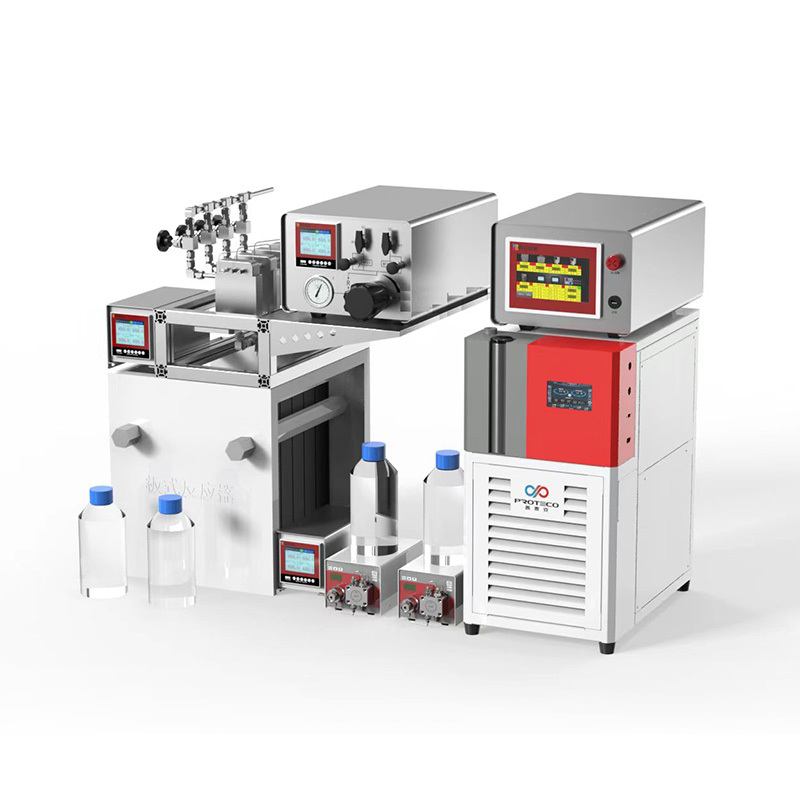

Flow Hydrogenation Reactor
Hydrogenation is one of the more important reactions in chemical synthesis; however, the inherent hazards associated with hydrogen have limited its widespread application. In a continuous-flow hydrogenator, the substrate flows continuously and is mixed with hydrogen generated via in-situ electrolysis before entering the reaction chamber. Thanks to the advancements in microfluidic technology, the efficiency of three-phase mixing is significantly enhanced. The hydrogen–substrate mixture can be rapidly and uniformly heated to 150°C and 100 bar; under these conditions, most reactions achieve extremely high conversion rates in just a few minutes. Within the catalytic column, the hydrogen–substrate mixture comes into effective contact with the catalyst surface, undergoing rapid reactions under high temperature and high pressure before being collected after passing through a filter. Within just a few minutes, it is possible to reduce 10 mg to 100 g of reactants with exceptionally high conversion yields. The system is operated via a touch-screen display, offering simple operation, a high degree of intelligence, and the ability to modify reactions on‑line.
查看详情
Joule Heating Fixed Bed
The Joule-heated fixed bed uses pulsed or steady DC current output from a Joule heating power supply to rapidly heat the reaction tube. Combined with precise control of gas input, preheating, and auxiliary heating within the reactor body, it achieves the conditions required for the reaction. Compared with traditional heating methods, Joule heating can significantly improve reaction efficiency and reduce operating costs. Moreover, the design of the Joule-heated fixed bed offers high flexibility: you can choose to upgrade a conventional furnace to a Joule heating power supply based on actual needs, or add a Joule heating power supply while retaining the existing conventional furnace, thereby meeting the requirements of various processes and experiments.
查看详情
Catalytic Cracking Micro Fixed-Bed Reactor
The catalytic cracking microfixed-bed reactor is a laboratory-scale device used to simulate industrial catalytic cracking processes. It typically consists of a small fixed-bed reactor packed with a specific catalyst, which facilitates the cracking of hydrocarbon feedstocks under high-temperature and high-pressure conditions. This type of apparatus enables researchers to investigate, in a controlled environment, the kinetics of cracking reactions, catalyst performance, product distribution, and the influence of reaction conditions on the cracking process. The design and operation of the catalytic cracking microfixed-bed reactor demand a high degree of precision to ensure the reliability and reproducibility of experimental results. Researchers must select appropriate catalysts and reaction conditions based on their experimental objectives, and perform proper calibration and maintenance of the apparatus. By using this device, industrial catalytic cracking processes can be simulated on a smaller scale, providing crucial experimental data for catalyst development, process optimization, and the study of reaction mechanisms.
查看详情
Membrane Reactor Fixed-Bed Evaluation System
The membrane reactor fixed-bed evaluation unit is primarily used to evaluate and study process operations, explore optimal process parameters, and provide foundational design data for pilot-scale and industrial-scale process design. It features a high‑precision electronic metering system for gas and liquid feed, an integrated nano‑scale membrane tube sparging module that transforms liquid substrates into a milky emulsion-like state. The membrane tube assembly includes a visual inspection window for real‑time monitoring, an ultra‑long constant‑temperature reaction zone, and a large loading capacity of 50 mL.
查看详情
Fixed-Bed Catalyst Evaluation System
The fixed-bed catalyst evaluation unit can be used to assess key performance indicators such as catalyst activity, selectivity, stability, and lifespan. By adjusting reaction conditions—including temperature, pressure, gas composition, and flow rate—different industrial reaction environments can be simulated, enabling a comprehensive evaluation of the catalyst’s performance in real-world applications. The ester and alcohol preparation continuous flow synthesis system is primarily used for research on continuous flow synthesis processes. The system is designed with two reactors that can be switched between operations, allowing for the execution of various types of continuous flow reactions. It is mainly employed to evaluate and study process parameters, explore optimal operating conditions, and, through sampling, analysis, evaluation, and data processing, obtain data on product distribution and product properties. This facilitates the transition from batch to continuous reaction processes and provides foundational design data for pilot-scale and industrial-scale process development.
查看详情
Fixed-Bed Heater
A fixed-bed heater is an experimental apparatus commonly used in fields such as chemical engineering, materials science, and energy research. It primarily consists of a furnace body, a heating system, a control system, an atmosphere control system, a reactor, and a product collection system. The furnace body is typically constructed from high‑temperature–resistant materials, such as stainless steel or special alloys, to withstand prolonged exposure to high temperatures and potential corrosive environments. Inside the furnace body is a fixed‑bed reactor, which is packed with catalysts or solid materials under investigation. The heating system is the core component of the fixed‑bed heater and can utilize electric heating, gas combustion, or other heat sources to supply thermal energy. Electric heating systems convert electrical energy into thermal energy via electric heating wires or heating elements, while gas combustion systems generate heat by burning natural gas, propane, or other fuels. The control system is responsible for regulating the temperature and atmosphere within the heater, ensuring that reactions proceed under optimal conditions. Temperature control is usually achieved using PID controllers in conjunction with temperature sensors such as thermocouples or RTDs. The atmosphere control system allows for precise adjustment of the gas composition and pressure inside the furnace, and may also include flow meters and gas analyzers to monitor gas flow rates and compositions. The product collection system is used to collect and analyze the products generated after the reaction. Depending on the nature of the reaction, this system may comprise components such as condensers, separators, and gas scrubbing bottles. The design and operation of a fixed‑bed heater must take into account factors such as the reaction’s thermodynamic characteristics, the stability of the catalyst, the properties of the feedstock, and the desired purity of the target products. Proper design and operation can enhance experimental efficiency, optimize product yield and quality, while also ensuring the safety of the experimental process.
查看详情
Headquarters Factory: No. 101-102, Lane 666, Xianing Road, Jinshan District, Shanghai
Telephone:021-55077056
E-mail:yly@yanzheng17.com
Sweep and add WeChat
Online consultation


